 Tone Caliper
Global saturation and the chroma curve
Set the color intensity of the whole photo with the Saturation slider, then shape it precisely with the chroma curve — hue-true, and respecting the colors you've protected.
A color pin changes one color. The Saturation slider changes them all at once — the color intensity of the whole photo, in one move. It sits at the top of the Color tab, above the wheel. For fine control, the chroma curve shapes that intensity by how colorful each area already is.
The Saturation slider
Drag right to raise color intensity, up to 200%; drag left to lower it, down to 0% (fully gray). The default is 100% — the tick at the center of the track — and the readout at the right shows the current percentage. Double-click the slider to snap back to 100%.
The move is hue-true: it scales chroma while holding hue and lightness fixed, so colors become more or less colorful without shifting which color they are.
The chroma curve
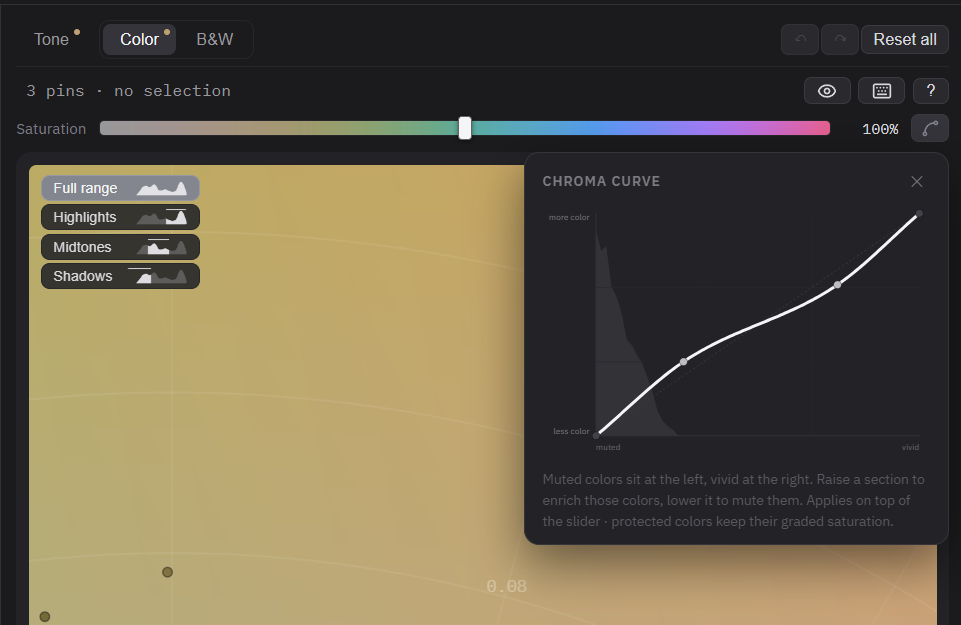
For precise control, click the curve button at the right end of the row. A floating Chroma curve panel opens.
Read the axes. The horizontal axis is how colorful an area already is — muted on the left, vivid on the right. The vertical axis is the result: less color at the bottom, more color at the top. The gray shape behind the curve is your photo's chroma histogram, showing where its colors fall along that muted-to-vivid range.
Raise or lower a section. Lift part of the curve to enrich the colors in that range; pull it down to mute them. This is how you enrich the muted colors while leaving the already-vivid ones untouched — or tame only the most saturated colors and nothing else.
Shape it with points. Click the plot to add a point and drag to move it; the two endpoints also drag inward, setting where muted and vivid begin. To remove a point, double-click it, right-click it, or click the ✕ on it.
The curve works on top of the slider: the slider sets the overall level, the curve reshapes it.
Protected colors keep their saturation
Global saturation respects the colors you've protected. If you've shielded a color — a skin tone, say — with a protect pin, it holds the saturation you graded it to even as you push the global slider or curve up and down. The protection is yours to place, on whatever colors this photo needs, rather than a fixed guess about which pixels are skin.
For placing and shaping individual colors, see Editing colors; for what the wheel's axes mean, see The color wheel.
Try this with your own photo — Tone Caliper is a free trial on Windows and macOS.
Download free trial